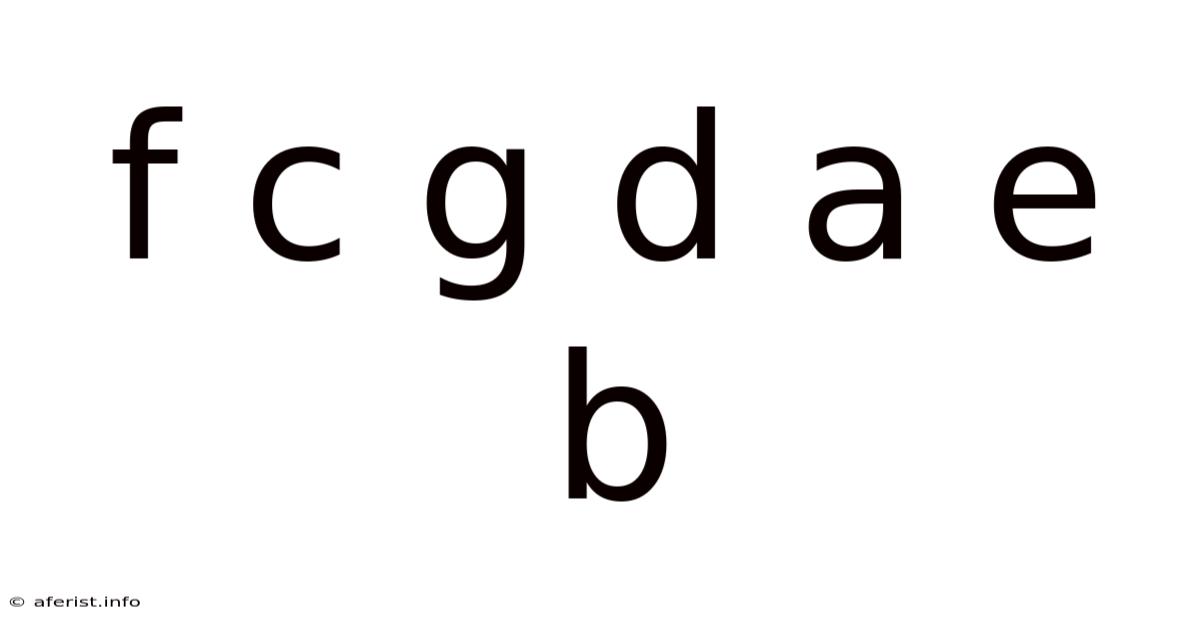
Understanding the F C G D A E B Note Order: A Foundation for Music Theory
This article explores the seemingly simple sequence of notes: F, C, G, D, A, E, B. While appearing basic at first glance, this order represents a fundamental concept in music theory, crucial for understanding scales, chords, and key signatures. Because of that, we'll delve deep into its significance, exploring its mathematical underpinnings, its role in various musical contexts, and its implications for musicians of all levels. Understanding this sequence unlocks a deeper appreciation for the structure and beauty of music Worth keeping that in mind..
The Circle of Fifths: The Heart of the Matter
The sequence F C G D A E B isn't arbitrary; it represents the Circle of Fifths. Here's the thing — this circle is a visual representation of the relationships between the 12 notes in the chromatic scale, arranged according to intervals of a perfect fifth (seven semitones). Starting on C, a perfect fifth above is G, then D, A, E, B, F#, C#, G#, D#, A#, and finally back to F. The sequence F C G D A E B represents the major keys within the Circle of Fifths, moving clockwise Which is the point..
Why is the Circle of Fifths so important? It reveals several key aspects of music theory:
-
Key Relationships: It illustrates the close harmonic relationships between keys. Keys adjacent on the circle share many chords and are often found together in musical pieces. As an example, C major and G major share several chords, making transitions between them smooth and natural.
-
Relative Minor Keys: The relative minor key of a major key is found three steps down the Circle of Fifths. Here's one way to look at it: the relative minor of C major is A minor.
-
Key Signatures: The number of sharps or flats in a key signature directly correlates with its position on the Circle of Fifths. As you move clockwise, the number of sharps increases, and as you move counter-clockwise, the number of flats increases The details matter here..
-
Chord Progressions: Understanding the Circle of Fifths helps in constructing effective and pleasing chord progressions. Many common chord progressions put to use keys adjacent to each other on the circle.
Mathematical Underpinnings: Frequencies and Ratios
About the Ci —rcle of Fifths isn't just a musical convention; it reflects deep mathematical relationships between musical notes. This ratio, when applied repeatedly, generates the sequence of notes in the Circle of Fifths. On the flip side, due to the limitations of equal temperament tuning, the perfect fifth is only an approximation of the true 3:2 ratio. Each note has a specific frequency, and the perfect fifth interval is characterized by a frequency ratio of approximately 3:2. This slight imperfection is why, after 12 perfect fifths, you don't quite land back on the original note, creating the phenomenon of the wolf interval But it adds up..
The underlying mathematical harmony reflected in the Circle of Fifths is a testament to the deep connections between mathematics and music. This mathematical basis contributes to the inherent beauty and coherence of musical structures built upon this system. Many composers and theorists have explored and expanded upon these mathematical relationships, leading to further developments in musical theory and composition.
Practical Applications: Scales, Chords, and Composition
The F C G D A E B sequence, derived from the Circle of Fifths, is vital for understanding various musical elements:
-
Major Scales: Each note in the sequence (F, C, G, D, A, E, B) represents the tonic of a major scale. A major scale is built using a specific pattern of intervals (whole, whole, half, whole, whole, whole, half). Understanding the Circle of Fifths allows for easy construction of any major scale.
-
Minor Scales: The relative minor scales are found three steps down from their corresponding major keys on the Circle of Fifths. To give you an idea, A minor is the relative minor of C major Still holds up..
-
Chords: The notes within each major key, as determined by the Circle of Fifths, form the basis of major and minor chords. As an example, the chords in C major are C major, G major, and A minor, reflecting the key's position and relationships within the circle.
-
Modulation: The Circle of Fifths is instrumental in understanding and implementing modulation – the process of changing keys within a musical piece. Smooth and effective modulations often involve moving to keys adjacent on the circle, taking advantage of their harmonic relationships.
Beyond the Basics: Advanced Applications
The Circle of Fifths extends far beyond basic music theory. It's a powerful tool for:
-
Improvisation: Experienced musicians use the Circle of Fifths to deal with through keys and chord progressions during improvisations, creating melodic and harmonic coherence Easy to understand, harder to ignore..
-
Harmonic Analysis: Analyzing existing musical works becomes easier with an understanding of the Circle of Fifths. You can track key changes, identify harmonic functions, and understand the composer's harmonic choices.
-
Composition: Composers consciously or unconsciously use the Circle of Fifths to create compelling and structurally sound pieces. Understanding the circle allows for more deliberate and creative harmonic choices.
-
Arranging: Arranging music for different instruments or ensembles often involves considering the keys and their relationships within the Circle of Fifths to optimize the overall sound and balance.
Frequently Asked Questions (FAQ)
Q: What is the difference between the Circle of Fifths and the Circle of Fourths?
A: The Circle of Fourths is simply the Circle of Fifths traversed in the opposite direction. It starts with C and moves counter-clockwise, showing the relationship between keys using intervals of a perfect fourth (five semitones). It's essentially the same information, just presented differently No workaround needed..
Q: Why is the Circle of Fifths circular?
A: The circular nature illustrates the cyclical relationship between keys. Moving through perfect fifths eventually brings you back to the starting point (though not perfectly due to the limitations of equal temperament). This cyclical pattern reflects the inherent repetition and interconnectedness found in musical structures And that's really what it comes down to..
Q: Is the Circle of Fifths applicable to all musical genres?
A: While predominantly used in Western tonal music, the principles of the Circle of Fifths can be applied (with some modifications) to analyze and understand harmony in other musical traditions. On the flip side, non-tonal or atonal music may not adhere to these traditional harmonic structures Simple, but easy to overlook..
Short version: it depends. Long version — keep reading.
Q: Can I learn to use the Circle of Fifths without formal music training?
A: While formal music training is beneficial, understanding the Circle of Fifths is achievable with self-study and practice. Also, many resources, including online tutorials and textbooks, explain the concept in accessible ways. Active engagement with musical examples is key to internalizing the knowledge.
Q: How does the Circle of Fifths relate to key signatures?
A: The number of sharps or flats in a key signature directly corresponds to its position on the Circle of Fifths. Each step clockwise adds a sharp, while each step counter-clockwise adds a flat. This allows for quick identification of the key signature based on the key's location on the circle.
Conclusion: A Journey into Musical Harmony
The sequence F C G D A E B, representing the major keys in the Circle of Fifths, is far more than a simple list of notes. Mastering this fundamental concept empowers musicians to analyze, compose, improvise, and appreciate music on a much deeper level. Still, whether you're a beginner or an experienced musician, exploring the intricacies of the Circle of Fifths is a journey well worth undertaking, unlocking a deeper understanding of the beauty and complexity of musical harmony. Day to day, it's a gateway to understanding the profound mathematical and musical relationships that underpin Western music. Through the Circle of Fifths, we gain a deeper appreciation for the layered structure, the interconnectedness of keys, and the creative possibilities within tonal music. From basic scale construction to sophisticated harmonic analysis, the Circle of Fifths remains a cornerstone of music theory and practice Simple, but easy to overlook. But it adds up..
