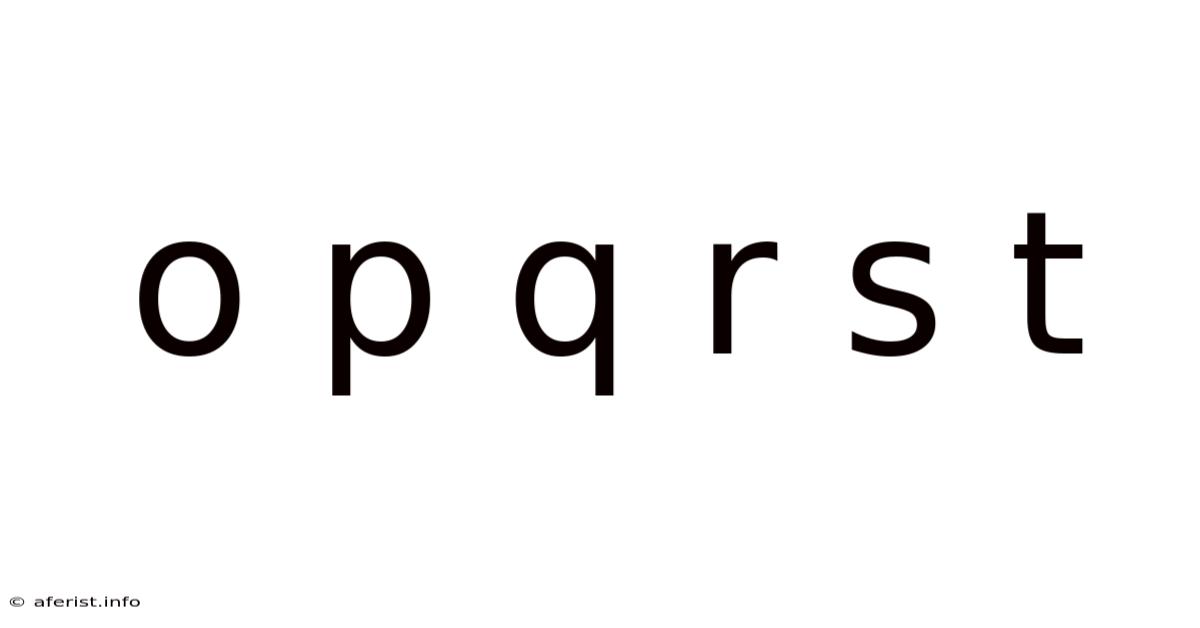
Decoding the Alphabet: A Deep Dive into O, P, Q, R, S, and T
This article provides a comprehensive exploration of the letters O, P, Q, R, S, and T, examining their linguistic origins, phonetic properties, common usage in words, and their significance across various fields like mathematics, science, and music. We'll get into the fascinating world of these seemingly simple symbols, revealing their rich history and multifaceted roles in communication and beyond. This honest look will enhance your understanding of the building blocks of language and the power of the alphabet Worth knowing..
I. The Letter O: A Circle of Sound and Meaning
The letter "O" holds a unique position in the alphabet. Its round shape visually reflects its often open and resonant sound. The origin of "O" traces back to the Phoenician letter 'ayin, representing a glottal sound (a sound produced by constricting the vocal cords). The Greeks adopted this letter, and its evolution across various alphabets resulted in the "O" we know today.
-
Phonetics: "O" represents a range of vowel sounds, depending on the language and context. In English, it can represent sounds like the "o" in "dog," "go," or "bone," each subtly different. The pronunciation varies across dialects and accents, making "O" a versatile and adaptable sound.
-
Usage and Significance: The letter "O" is frequently used in words, often associated with concepts of completeness, wholeness, or roundness (e.g., circle, globe, ocean). In mathematical notation, "O" can represent "order" or be part of symbols like zero (0) and Ohm (Ω). In music, "O" may represent an octave. Its versatility extends across disciplines.
II. The Letter P: Power and Precision
The letter "P" is another ancient glyph, tracing its origins back to the Phoenician letter pe, representing a voiceless bilabial plosive sound – that is, a sound made by stopping the airflow with both lips. Its evolution into the modern "P" is relatively straightforward across various alphabets Worth keeping that in mind. That's the whole idea..
-
Phonetics: The sound represented by "P" is typically consistent across languages, representing a voiceless bilabial stop. This means air is stopped by the lips before being released with a burst of sound.
-
Usage and Significance: "P" is a common letter, appearing in a wide variety of words. It's often associated with power, precision, or pressure (e.g., powerful, precise, pressure). In chemistry, "P" often represents phosphorus. In physics, it frequently stands for pressure or power Most people skip this — try not to. Turns out it matters..
III. The Letter Q: A Unique Combination
"Q" stands out as one of the less frequent letters in the alphabet. Its unique characteristic is its near-inseparable connection with the letter "U." The letter's origin is rooted in the Phoenician letter qoph, representing a voiceless velar stop (a sound produced by stopping airflow at the back of the mouth) Not complicated — just consistent..
It sounds simple, but the gap is usually here Easy to understand, harder to ignore..
-
Phonetics: In most languages, "Q" is almost always followed by "U," often creating a /kw/ sound, as in "queen" or "quick." The sound can vary slightly depending on the dialect.
-
Usage and Significance: Because of its limited usage and frequent combination with "U," "Q" holds a less prominent position compared to other letters. Its rarity might contribute to its perception as somewhat unusual or elegant And it works..
IV. The Letter R: Rolling and Vibrating
The letter "R" is a vibrant letter both visually and phonetically. Its origins lie in the Phoenician letter resh, representing a voiced alveolar trill or tap (a sound made by vibrating the tongue against the alveolar ridge).
-
Phonetics: The sound of "R" varies greatly across languages. English possesses several allophones of “R,” varying in pronunciation depending on dialect and position within a word. Some languages, like Spanish, feature a strongly trilled "R," while others may have a tapped or even a voiced alveolar approximant.
-
Usage and Significance: The letter "R" is highly prevalent in many languages. In mathematics, it often represents radius, range or correlation. In chemistry, it can represent the ideal gas constant. Its frequent appearance and varied pronunciation contribute to its linguistic adaptability.
V. The Letter S: A Sound of Silence and Sound
The letter "S" boasts a rich history, stemming from the Phoenician letter samekh, representing a voiceless alveolar fricative (a hissing sound made by forcing air through a narrow channel).
-
Phonetics: "S" is a common voiceless alveolar fricative sound, characterized by a hissing sound. The sound is relatively consistent across languages, though subtle variations can occur in pronunciation, particularly depending on adjacent sounds. In some languages, "S" can also represent other related sounds.
-
Usage and Significance: "S" is extremely frequent, appearing in a vast number of words. In grammar, it often marks the plural form of nouns. In mathematics, it can represent a variety of things depending on context, such as seconds (s), standard deviation, or the variable in an equation. Its versatility extends across various disciplines Still holds up..
VI. The Letter T: A Universal Sound
"T" traces its roots back to the Phoenician letter taw, representing a voiceless alveolar stop (a sound made by stopping airflow with the tongue against the alveolar ridge). It's a fundamental letter with a consistent sound across many languages That's the whole idea..
-
Phonetics: The "T" sound is a voiceless alveolar stop, a common and relatively consistent sound across various languages. Still, like many sounds, subtle variations can occur based on surrounding sounds and dialect.
-
Usage and Significance: "T" is exceptionally common in numerous languages, often found in words relating to time, action, or location (e.g., time, travel, today). In mathematics and science, it has various uses, representing temperature (T), time (t), or Tesla (T) in physics. Its prevalence underscores its importance in communication That's the whole idea..
VII. Interrelationships and Patterns
Examining these six letters together reveals interesting patterns and interrelationships. To give you an idea, "P" and "B" are cognates; similarly, “T” and “D” show a close phonetic relationship. The letters "O," "P," "Q," "R," "S," and "T" demonstrate the diversity and consistency of the alphabet, highlighting both the subtle variations and remarkable similarities in their sounds and usage across various languages and contexts. The evolution from ancient Phoenician origins to their modern forms demonstrates a continuous linguistic process Easy to understand, harder to ignore. Simple as that..
VIII. Frequently Asked Questions (FAQ)
-
Q: Why are some letters more frequent than others? A: Letter frequency is influenced by a complex interplay of factors, including the frequency of sounds in spoken language, the structure of words in a given language, and historical linguistic developments.
-
Q: How do the pronunciations of these letters vary across different languages? A: The pronunciation of "O," "P," "Q," "R," "S," and "T," while generally consistent across many languages, exhibits subtle variations based on dialect, neighboring sounds, and the overall phonetic system of the particular language.
-
Q: What is the significance of the shape of these letters? A: While the shapes of these letters are largely arbitrary in their current form, their origins often reflect the way sounds were initially represented visually in early writing systems. The evolution of letter shapes over millennia reveals the interplay of cultural and linguistic influences Simple, but easy to overlook..
-
Q: Are there any common words containing all six letters? A: Finding a single word containing all six letters in the same order or even within the word is unlikely due to the structure of English and most other languages. On the flip side, many words use combinations of these letters.
IX. Conclusion: The Power of the Alphabet
This exploration of the letters O, P, Q, R, S, and T reveals their rich history, diverse phonetic properties, and wide-ranging applications across various fields. Their consistent and yet versatile nature showcases the remarkable power and elegance of the alphabet. From their ancient origins to their modern uses, these seemingly simple symbols represent a fundamental component of human communication. So understanding the individual characteristics and interrelationships of these letters deepens our appreciation for the complexities and subtleties of language and its role in shaping our world. Further research into the etymology and usage of these letters within specific linguistic contexts can enrich this understanding even further The details matter here..
