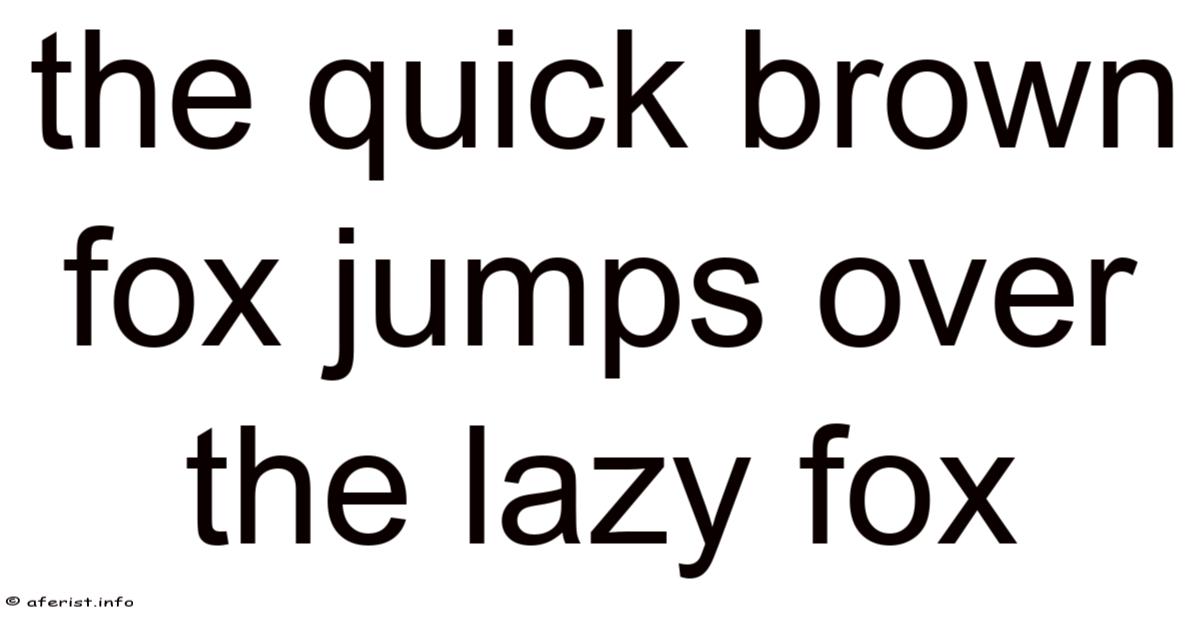
The Quick Brown Fox Jumps Over the Lazy Dog: A Deep Dive into a Linguistic Icon
The seemingly simple sentence, "The quick brown fox jumps over the lazy dog," is more than just a pangram – a sentence containing every letter of the alphabet. It's a linguistic icon, a testament to the power and beauty of the English language, and a fascinating subject for exploration across various fields. This article will get into its history, its linguistic significance, its use in various contexts, and even explore the subtle nuances of its meaning. We'll uncover why this seemingly simple sentence holds such enduring appeal Simple, but easy to overlook..
The Pangram's Origins: A Journey Through Time
While the exact origin of the sentence remains shrouded in some mystery, its widespread use can be traced back to the era of early typewriters and printing technology. Consider this: in the pre-digital age, verifying the proper functionality of a typewriter or a typesetting machine was crucial. And this sentence, containing every letter, provided a convenient and efficient way to test all the keys, ensuring each character printed correctly. Consider this: the ease of remembering and typing the sentence made it the perfect testing tool. Interestingly, variations existed, often substituting "dog" with "fox," resulting in the slightly redundant but more visually appealing "The quick brown fox jumps over the lazy fox.
Easier said than done, but still worth knowing.
Linguistic Significance: More Than Just a Test
Beyond its practical application in testing technology, the sentence offers a rich tapestry of linguistic elements worthy of examination.
-
Sentence Structure: The sentence follows a simple Subject-Verb-Object (SVO) structure, a common characteristic of English grammar. The subject ("The quick brown fox") performs the action ("jumps") on the object ("over the lazy dog"). This straightforward structure contributes to its memorability and ease of understanding Less friction, more output..
-
Adjectives and Nouns: The sentence showcases a variety of adjectives ("quick," "brown," "lazy") modifying the nouns ("fox," "dog"). This variety of descriptive words adds richness and imagery to the otherwise simple statement, making it more engaging. Note the contrast between "quick" and "lazy," suggesting a dynamic scene full of movement and contrasting energy levels Which is the point..
-
Verb Choice: The verb "jumps" is vivid and active, instantly creating a mental picture of the fox in motion. The choice of this verb, rather than a more passive alternative, further contributes to the sentence's dynamic quality Practical, not theoretical..
-
Prepositional Phrase: The phrase "over the lazy dog" uses a preposition ("over") to indicate the spatial relationship between the fox and the dog. This prepositional phrase adds another layer of detail and meaning to the sentence Worth keeping that in mind..
Beyond the Basics: Exploring Subtleties and Variations
The simplicity of the sentence allows for creative interpretation and variation. Consider these points:
-
The Redundancy of "Fox/Fox": While less common, "The quick brown fox jumps over the lazy fox" presents an interesting case of redundancy. This variation, while slightly less efficient for testing purposes, creates a sense of playful symmetry. The repetition emphasizes the contrast between the quick and the lazy, making the imagery potentially even more striking.
-
Imagery and Interpretation: The sentence evokes a vivid mental image, sparking the imagination of readers. One can easily picture the scene: a swift, brown fox gracefully leaping over a relaxed dog. This inherent imagery contributes to its memorability and overall effectiveness. The interpretation may vary slightly depending on the individual's perspective and experiences, adding another layer of complexity to its seemingly simplistic structure That's the whole idea..
-
Cultural Significance: While seemingly mundane, the sentence's ubiquity across various cultures and languages speaks to its inherent appeal and adaptability. The translation into other languages often preserves its core structure, showcasing the universality of its fundamental linguistic principles.
-
Use in Education: The pangram is frequently used in teaching typing skills, illustrating the different letter combinations and practice of finger placement on the keyboard. Its concise nature and consistent usage make it an excellent tool for reinforcing letter recognition and typing proficiency That alone is useful..
The Quick Brown Fox in Popular Culture: An Unexpected Star
The unassuming pangram has found its way into unexpected corners of popular culture, appearing in:
-
Typography and Design: The sentence frequently serves as an example showcasing a font's legibility and character set It's one of those things that adds up..
-
Programming and Computing: It's often employed in software testing to verify text rendering and output.
-
Art and Literature: Its use in literature and art is less frequent but occasionally serves as a motif or a quirky element contributing to its unexpected appeal Nothing fancy..
The ubiquitous nature of this seemingly simple sentence highlights its effectiveness as a functional tool while simultaneously showcasing its subtle yet captivating qualities.
Frequently Asked Questions (FAQ)
-
Why is it called a pangram? The term "pangram" refers to a sentence that uses every letter of the alphabet at least once.
-
What are some other pangrams? While "The quick brown fox jumps over the lazy dog" is the most popular, many other pangrams exist, often more complex or less memorable Worth knowing..
-
Why is this specific pangram so popular? Its brevity, simple structure, and vivid imagery contribute to its popularity and widespread use. Its efficiency as a testing tool also played a significant role It's one of those things that adds up. That's the whole idea..
-
Can the sentence be improved? While improvements are subjective, variations exist, often prioritizing specific artistic or stylistic choices. The original remains favored for its balance of simplicity and effectiveness Worth keeping that in mind..
Conclusion: A Timeless Linguistic Treasure
"The quick brown fox jumps over the lazy dog" transcends its simple structure and practical function. Here's the thing — it's a linguistic artifact, a concise yet potent example of the expressive power of language. Its continued use and relevance speak volumes about its effectiveness and enduring place within the history and evolution of the English language. From its humble beginnings as a typewriter test to its appearances in various aspects of popular culture, this sentence remains a fascinating study in linguistic form and function, highlighting the enduring appeal of clarity, conciseness, and vivid imagery. Consider this: the seemingly simple act of a fox jumping over a dog embodies a much richer tapestry of linguistic nuances and cultural significance than initially apparent. And it’s more than just a sentence; it’s a miniature masterpiece of linguistic engineering, a testament to the beauty and power of words. Its ongoing legacy ensures its place as more than just a useful tool; it's a cultural icon Worth keeping that in mind..
This changes depending on context. Keep that in mind It's one of those things that adds up..
